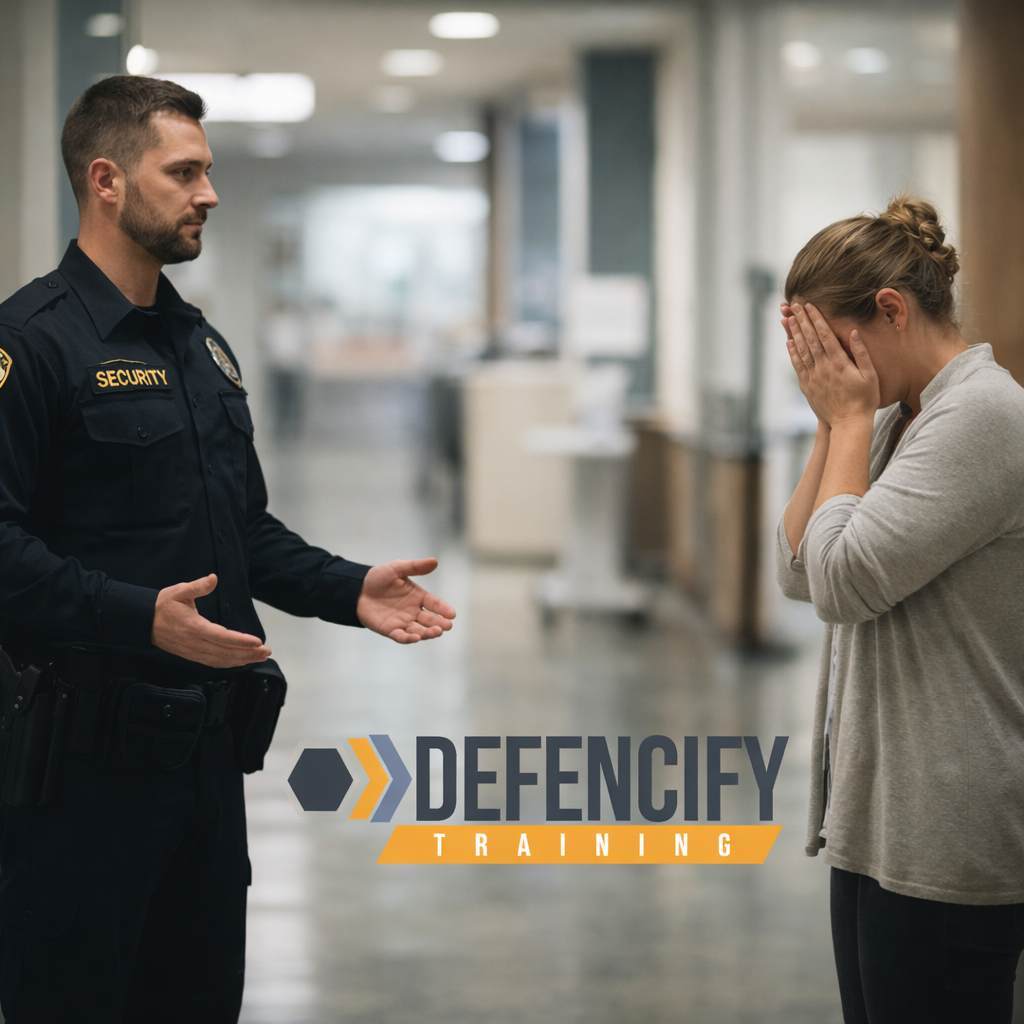
Security guards today face more diverse crises and situations than ever before. From mental health episodes to drug poisonings, neurodivergent individuals, and dealing with situations involving language barriers, new skills and training are necessary to support them in responding appropriately.
We’re talking about Human Response Training™, a set of crisis-response techniques that equips guards with the skills and insight they need to recognize and resolve some of today’s most prevalent crises—and do so safely, respectfully, and without undue liability or legal overreach.
During a crisis, how a guard responds is just as critical as the act of responding itself. Because guards are often the first at the scene, they don’t always have expert guidance close at hand and must know how to proceed safely, exercise good judgment, and prioritize safety over the use of force.
Human Response Training™ (HRT) is part of Defencify’s advanced competencies program. This four-hour course focuses on honing essential soft skills for navigating complex human interactions.
Modern Times, Modern Crises
Human response training is a crisis intervention strategy designed to address a range of issues, from addressing dangerous individuals who put their own or others’ lives at risk to de-escalating extreme behavior and emotional trauma, and helping communities respond to disasters, public health crises, or other disruptions.
The term itself refers to either large-scale human crises, like disasters or conflicts that involve populations, or individual crises, such as mental health episodes or neurodivergent behavior, as just a few examples.
Essentially, human response is a soft skill. The communication aspect of the technique is a critical component; without it, responders risk escalating a situation that could lead to poor outcomes, including injury, legal action, and even fatality.
Skills involved in human response include:
·
Communication: verbal de-escalation and professionalism, including situations that involve a language barrier.
·
Situational awareness: recognizing behavioral and emotional indicators.
·
Teamwork: working with other responders and the public toward a favorable outcome.
·
Ethical decision-making: staying calm under pressure and taking the lead when needed.
·
Empathy first: trauma-informed response where appropriate.
·
Setting boundaries: protecting the subject, the officer, and the public from further harm.
·
ADA responsibilities: appropriately supporting neurodivergent and differently abled individuals.
·
Responding appropriately to drug-related and medical emergencies.
In some jurisdictions, dedicated law enforcement officers are trained in human response or are paired with specially trained professionals, such as nurses, mental health professionals, or social workers, when such support is required.
Evidence shows that applying this strategy helps mitigate the use of force and, in some cases, has reduced arrests by 98%. By diverting individuals in crisis to community resources, emergency room visits are significantly reduced, pressure on the justice system eases, and public trust improves.
[i]
In today’s private security industry, clients expect that the guards they hire have the skills and knowledge to protect their interests.
By transforming how guards recognize and resolve the crises they face, we can reduce legal liability, ensure professionalism, and protect people, property, and the public from undue harm.
Learning Objectives in Human Response Training
Officers taking Defencify’s Human Response Training course will gain essential skills and insight to inform their responses to any human encounter on the job.
The following is an outline of the course curriculum and expected outcomes:
1.
Crisis Foundations
The ability to identify a crisis is the basis for all techniques in this module. Officers will learn to recognize the warning signs of a crisis forming through body language, behavior, and other physical cues.
Expected outcomes: guards will gain confidence in making sound, defensible decisions that reduce the risk of injury, psychological harm, and liability.
2.
Mental Health Crisis Recognition
The signs of a mental health crisis are often subtle. When trained to recognize the symptoms, officers can engage appropriately and direct the process towards the best possible outcome.
Expected outcomes: learn how to identify symptoms such as hallucinations, panic, paranoia, or PTSD, and apply the appropriate engagement protocol.
3.
Neurodivergence Awareness
To the untrained individual, spectrum disorders such as autism, ADHD, and sensory-driven behavior can mimic drug intoxication. Misinterpreting these signals or responding as you might if it were drug-related could inflame the situation and put the subject (and the officer and the public) at risk.
Expected outcomes: participants will learn communication techniques that prevent escalation and reduce the risk of injury.
4.
Communicating Across Language Barriers
Dealing with individuals who do not speak the same language can be challenging, doubly so if there is a tense situation or crisis that requires de-escalation. However, understanding is possible using various tools and strategies that bridge the communication gap.
Expected outcomes: learn communication strategies through gestures, simplified language, and active listening, empathy, and patience, emphasizing cultural sensitivity and recognizing non-verbal cues.
5.
Opioid Overdose Response
Opioid deaths can be avoided when the correct interventions are applied. Recognizing the signs of an opioid drug poisoning is the first step, but officers must act quickly and follow the protocol.
Expected outcomes: recognize the signs of opioid poisoning, activate emergency services, administer Naloxone, and proceed with trauma-informed care.
6.
Tactical De-Escalation (V.E.S.T. Framework)
The VEST framework is a trauma-informed technique that combines voice, empathy, space, and time with body positioning, environmental control, and tactical phrasing to de-escalate tense situations.
·
Voice – we ensure that people are heard and feel valued, especially neurodivergent individuals or those with mental health conditions.
·
Empathy – we accept what others are experiencing, tuning in to their frame of reference.
·
Space – creating a non-judgmental space where individuals can feel physically and emotionally safe.
·
Time – allowing extra time for individuals in crisis to process information, communicate in ways they know how, and to feel safe.
Expected outcomes: participants will become familiar with the VEST framework and learn to apply it in the context of liaising with people in crisis, including neurodivergent individuals.
Benefits of HRT for the Organization
Human response training is a valuable resource in many diverse settings. Some examples include healthcare facilities and hospitals, hospitality, retail security, entertainment, and sporting events. Contract security, private EMS, frontline safety workers, and any personnel who liaise with the public will benefit from HRT, as it is a vital aspect of harm reduction.
Security firms and their clients can look forward to fewer use-of-force incidents, reduced liability, and improved public trust due to more effective handling of mental health episodes and drug poisoning responses.
Today’s clients expect professionalism. Communities expect empathy. Courts expect documentation, and proof of HRT training goes a long way in supporting officer behavior and their choice of response.
For firms, HRT training adds value that resonates throughout the organization. Online delivery ensures consistency across teams, providing a verifiable audit trail suitable for legal process.
Get started with HRT: enroll your teams and get certified today.